> For the complete documentation index, see [llms.txt](https://docs.selectstar.com/llms.txt). Markdown versions of documentation pages are available by appending `.md` to page URLs; this page is available as [Markdown](https://docs.selectstar.com/learning-data/getting-started-databricks.md).
# Getting Started: Databricks
Learn how to connect to your Databricks data warehouse to Select Star and retrieve metadata from your datasets. This guide will provide you with the necessary steps to get started.
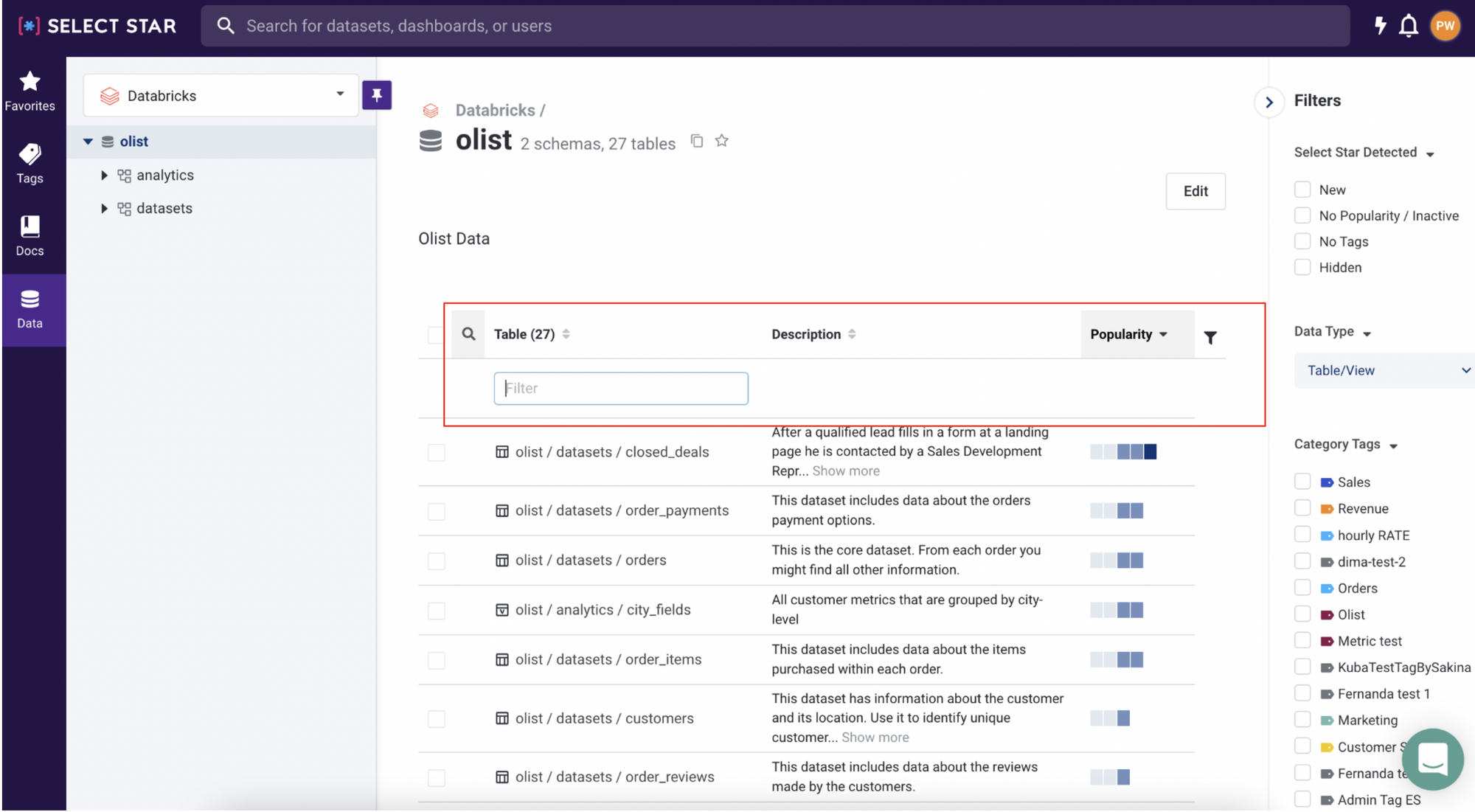
Click on a Databricks catalog in the left sidebar to see all schemas and tables in the catalog, ordered by Popularity.
## **Catalog Page**
From here, use `Cmd/Ctrl+F` or click the :mag: icon in the header to open a filter in the page.
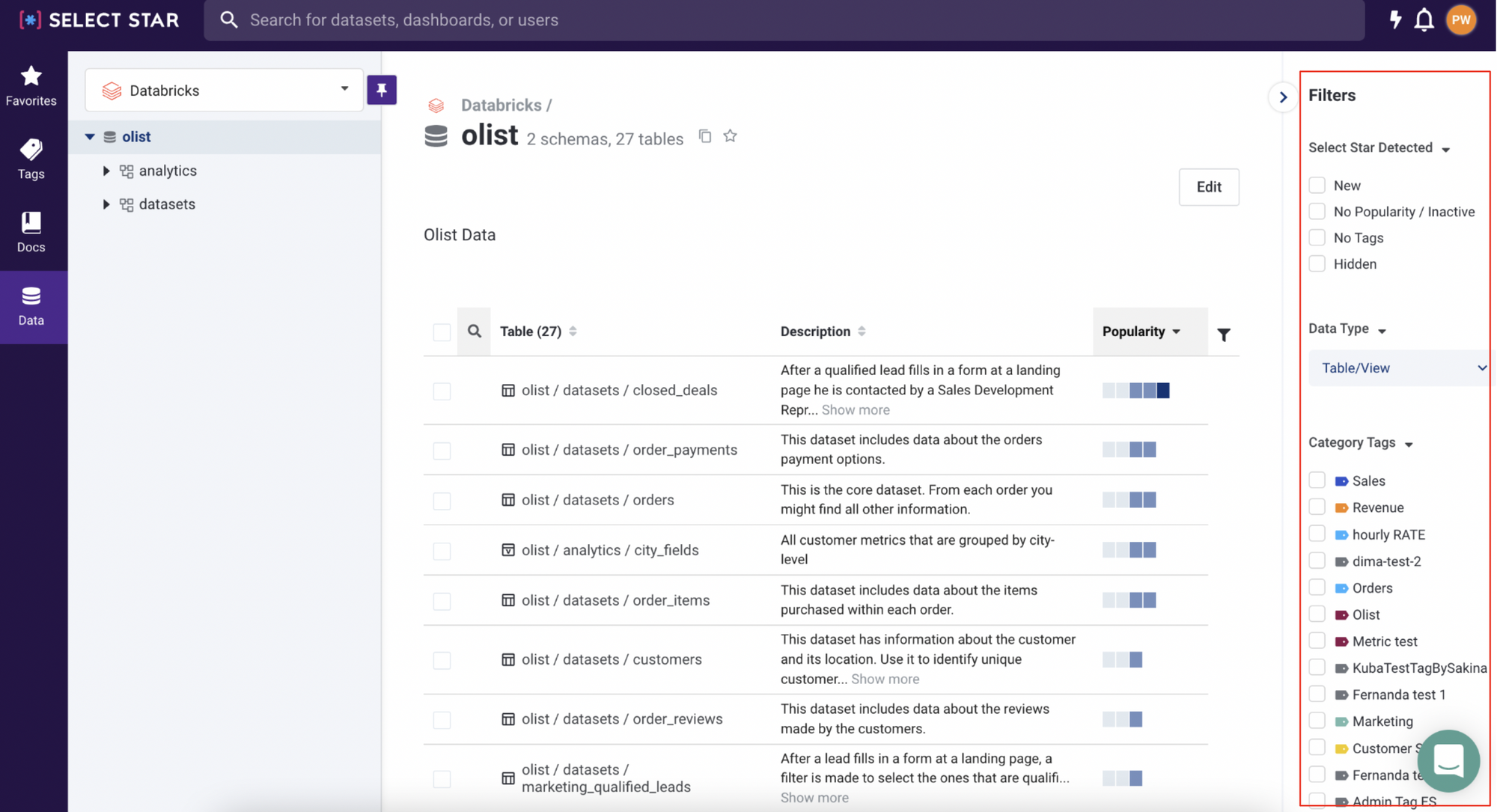
You can also use the **Filters** on the right side of the page.
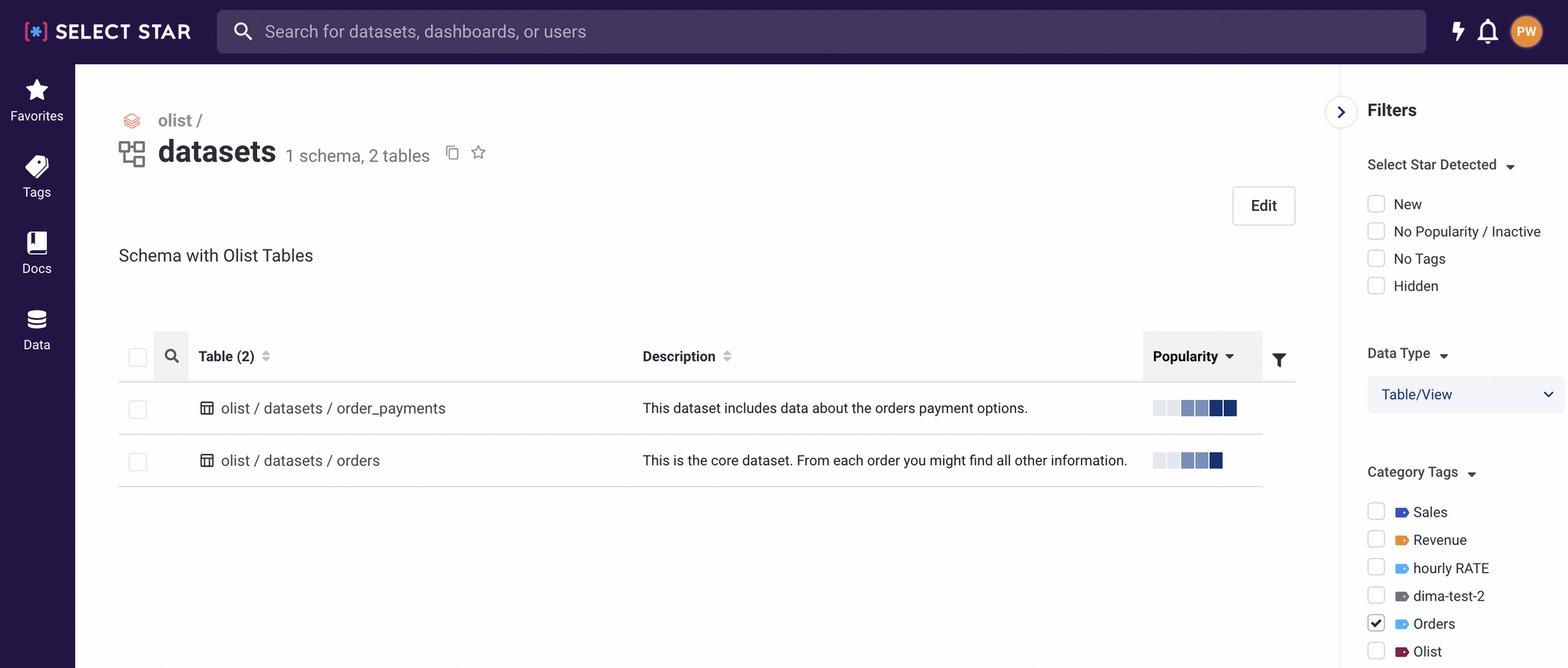
Check any of the [Category or Status Tag](https://docs.selectstar.com/features/tags) boxes to show data with those tags applied.
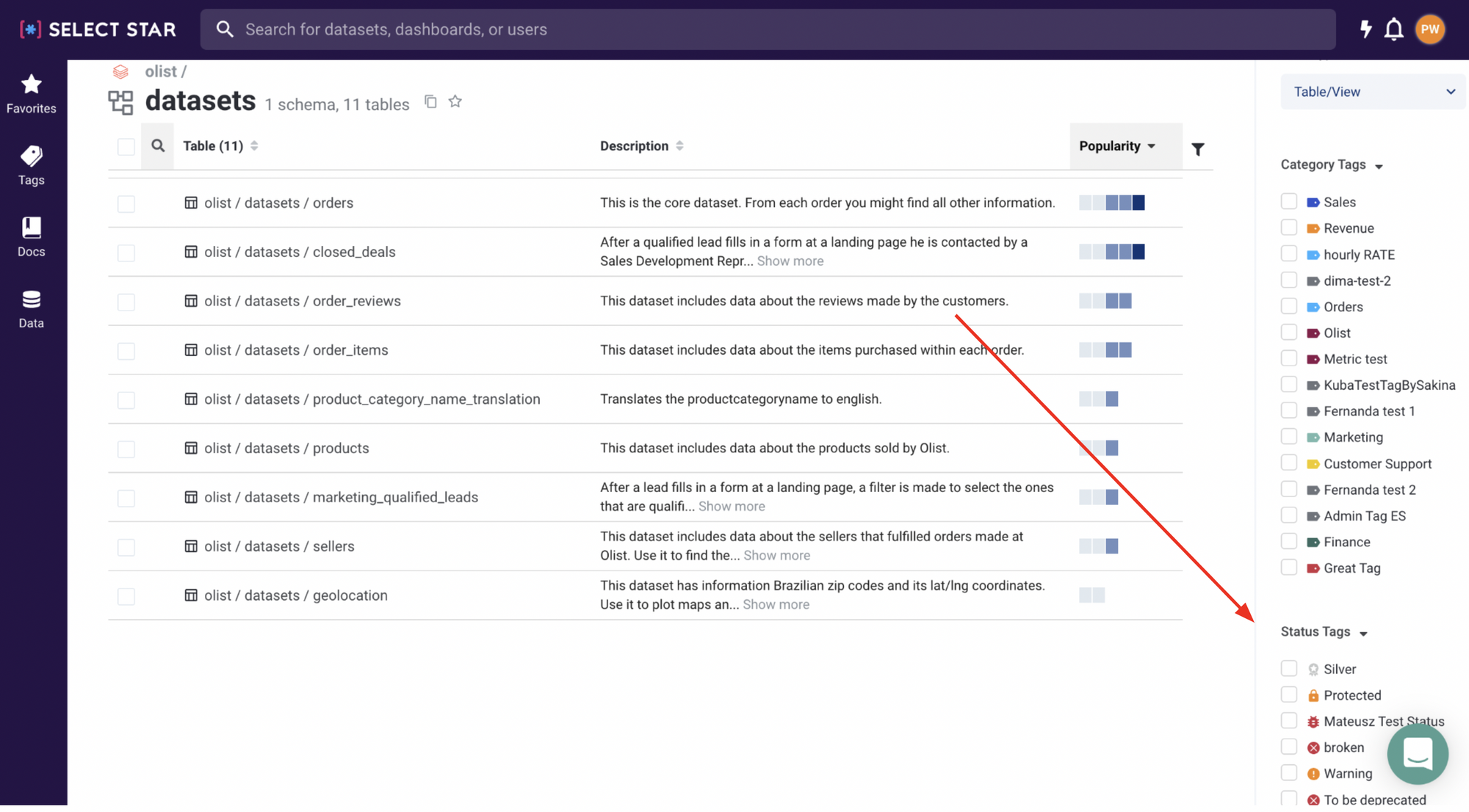
Scroll down in the page to see more filters.
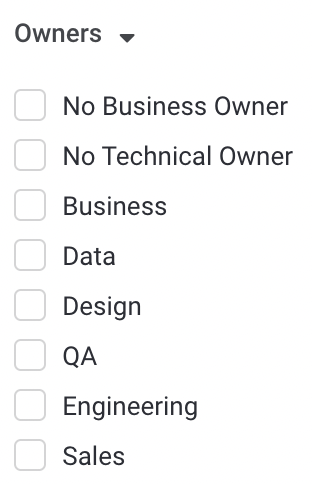
Find datasets which have no [Owners assigned](https://docs.selectstar.com/data-management/data-ownership), or ones which belong to specific users or teams.
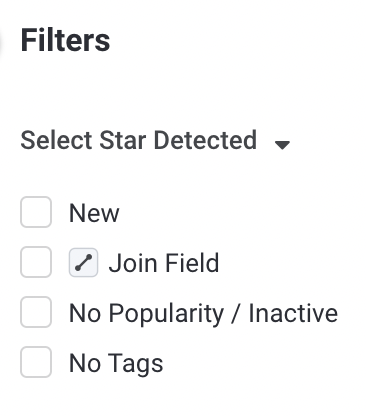
See your most popular and least popular datasets, as well as those with no popularity, documentation, or tags. These filters can help you identify where you need to [add documentation](https://docs.selectstar.com/data-management/add-documentation) or distinguish between excellent and subpar datasets [using tags](https://docs.selectstar.com/data-management/tag-management).
## **Column View**
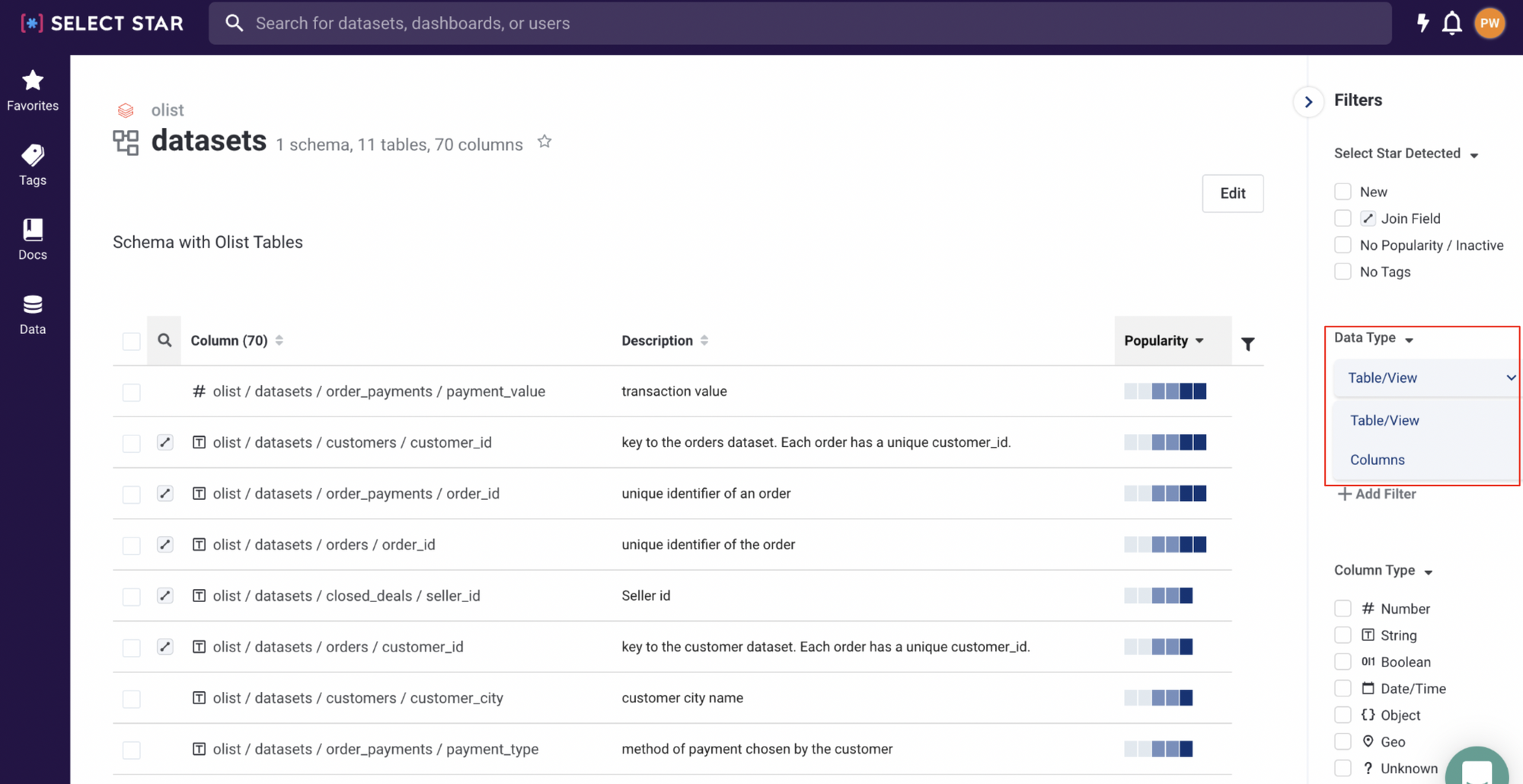
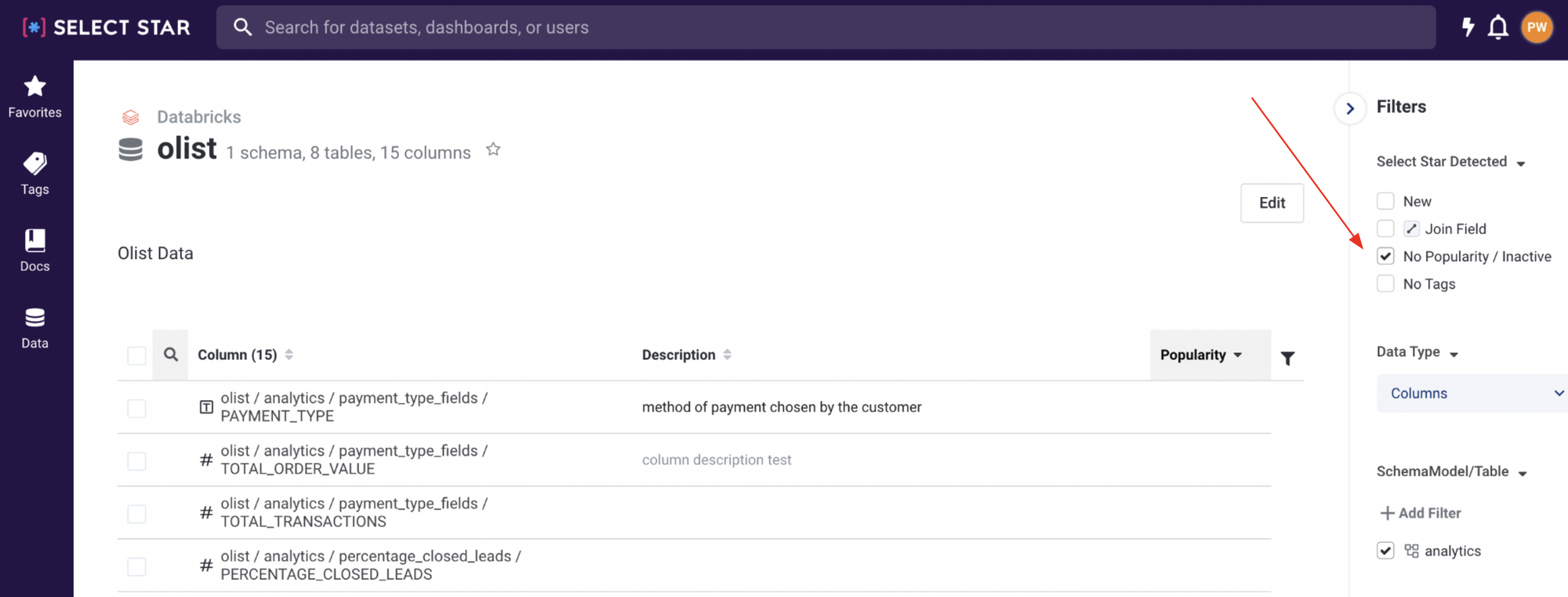
Change the Data Type in the dropdown to see all columns in a catalog/schema. It will show all tables and views by default.
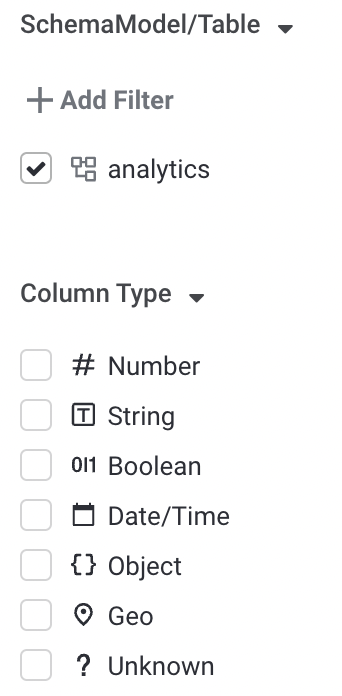
When looking at columns, you can do more granular work than the table view, but broader work than viewing an individual table. You can filter based on schema or table in the right sidebar, or find columns of a certain data type.
Unknown column types are any column types not represented by the other filters. Unless you are using custom type fields, you should not expect to have any.
You can still filter by Tags and Popularity. The column-level view will also show and have a filter for columns used to join to other tables.
Showing only columns with No Popularity/Inactive in the Analytics Schema
## **Table Page**
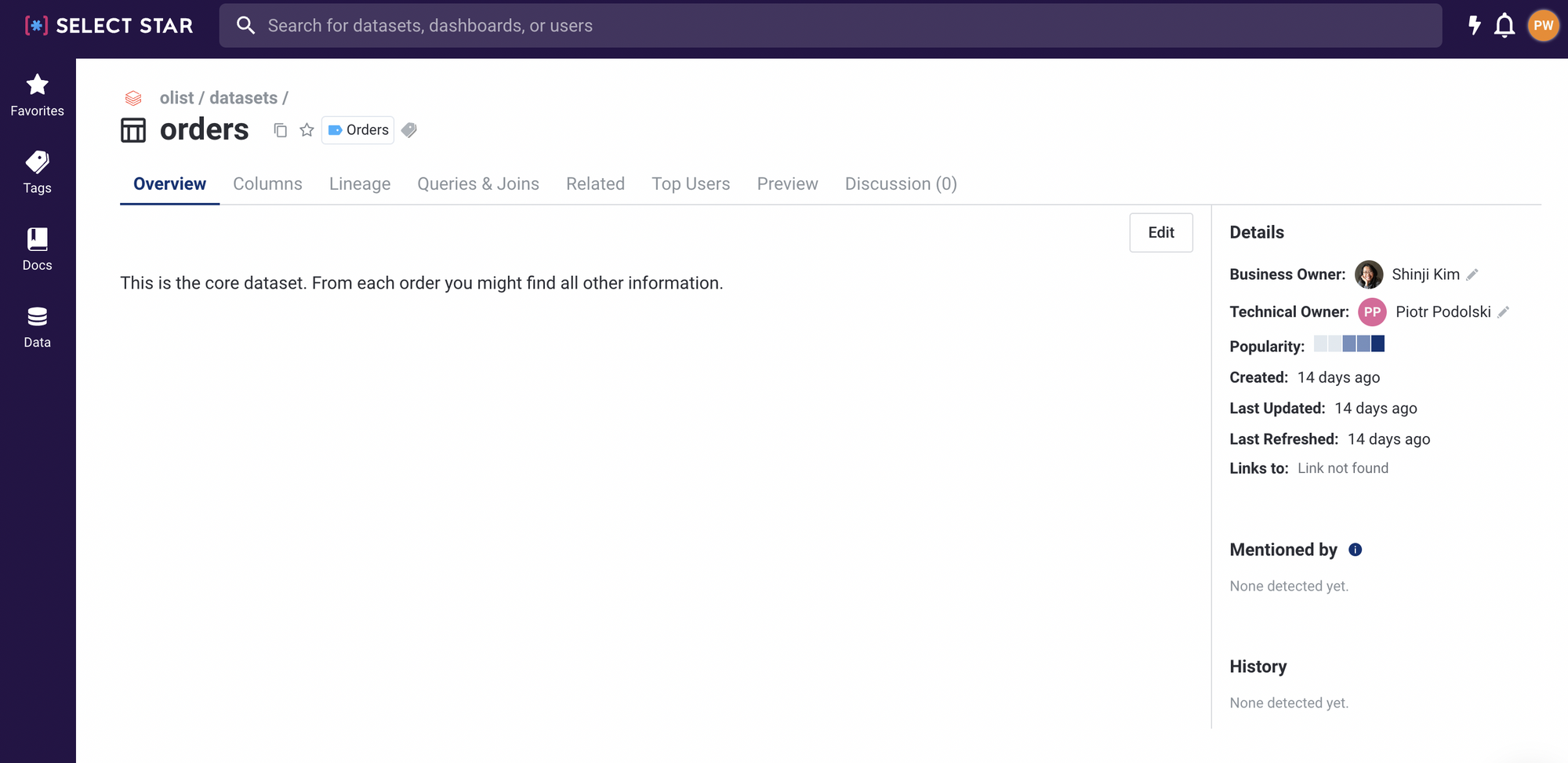
Click on a table or column from the Catalog page to see detailed information about that table, such as table lineage, common queries run on the table, Downstream Dashboards, and more.
Explore the table page in more detail by clicking the link below.
{% content-ref url="/pages/-MiXUMWODT7Itc685YFN" %}
[Table Page](/features/table-page.md)
{% endcontent-ref %}
---
# Agent Instructions
This documentation is published with GitBook. GitBook is the documentation platform designed so that both humans and AI agents can read, navigate, and reason over technical content effectively. Learn more at gitbook.com.
## Querying This Documentation
If you need additional information that is not directly available in this page, you can query the documentation by asking a question.
Perform an HTTP GET request on the following URL with the `ask` and `goal` query parameters:
```
GET https://docs.selectstar.com/learning-data/getting-started-databricks.md?ask=&goal=
```
`ask` is the immediate question: it should be specific, self-contained, and written in natural language.
`goal` is what the user is ultimately trying to achieve, the reason they need the answer. Sharing it helps GitBook give you a better, more relevant answer. A goal is most helpful when it describes the outcome the user wants rather than restating the question. For example, with `ask=how do I create an API token`, a goal like `automate deployments from our CI pipeline` lets GitBook tailor the answer to that use case.
The response will contain a direct answer to the question and relevant excerpts and sources from the documentation.
Use this mechanism when the answer is not explicitly present in the current page, you need clarification or additional context, or you want to retrieve related documentation sections.